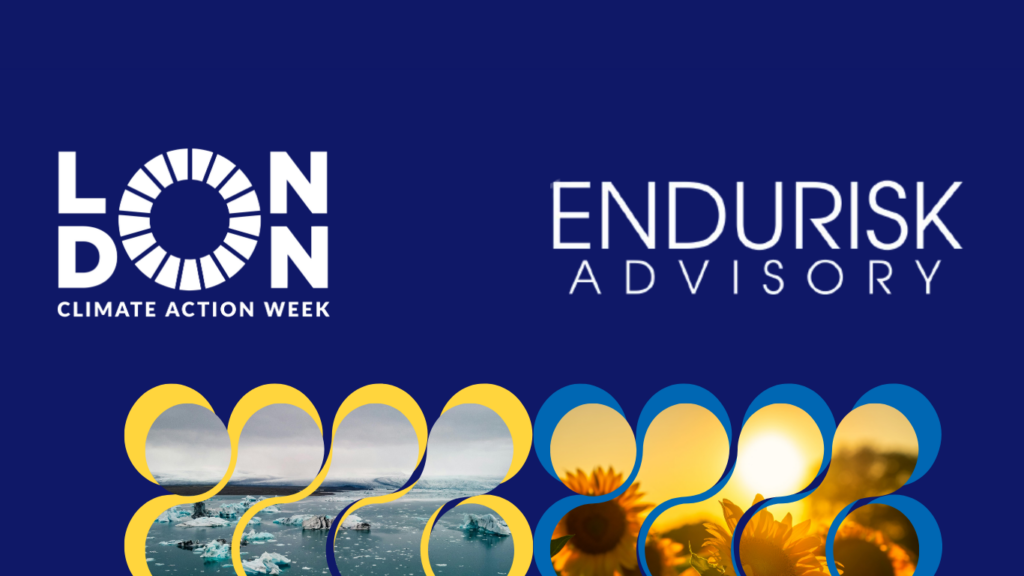
Endurisk Advisory Is Hosting Three Events at London Climate Action Week 2026
Endurisk Advisory Is Hosting Three Events at London Climate Action Week 2026 London Climate Action Week is one of the world’s most important gatherings of climate finance professionals, sustainability leaders and policy voices. This June, Endurisk Advisory is proud to be part of it — hosting three events that we believe speak directly to the questions that matter most right now in sustainable finance and corporate sustainability. Here is what we are doing, why, and how you can join us. Why We Are at London Climate Action Week The sustainable finance agenda has matured significantly over the past five years. The frameworks are in place. The pledges have been made. The capital is, in theory, flowing. But a set of harder, more uncomfortable questions is beginning to surface — questions about whether the commitments are credible, whether the numbers are real, and whether organisations are genuinely delivering on what they have promised. These are the questions Endurisk Advisory was built to address. Our work sits at the intersection of sustainability, risk, governance and evidence — and London Climate Action Week is the right platform to bring that perspective into the global conversation. Event 1 — Measure to Manage: A Masterclass in Carbon Accounting and ESG Reporting Monday 23 June 2026 3:00 PM BST | 6:00 PM GST | 7:30 PM IST Online | You cannot manage what you cannot measure. This one-hour masterclass cuts through the complexity of carbon accounting and ESG reporting to give professionals a practical, usable grounding in the fundamentals — from the GHG Protocol and Scope 1, 2 and 3 emissions, to IFRS S1/S2, TCFD and the Science Based Targets initiative. This session is designed for sustainability managers, finance and operations professionals, and senior leaders who need to understand what credible carbon accounting looks like. No prior technical knowledge is required. Register here: https://luma.com/wsa3aa4l Event 2 — Who’s Counting? Carbon, Capital and the Credibility of Sustainable Finance Tuesday 24 June 2026 10:30 AM BST | 1:30 PM GST | 3:00 PM IST Online | This is the event we have been building toward with our independent research programme. The sustainable finance market is enormous in ambition and growing in volume — but the credibility gap is real, and it is widening. Financed emissions — the carbon footprint embedded in lending and investment portfolios — typically represent around 99% of a financial institution’s total climate impact. Yet measurement and disclosure remain inconsistent across markets. Net zero commitments are near-universal but transition plans are not. ESG ratings from different agencies for the same institution can diverge dramatically. This panel brings together impact investors, banking and finance professionals and sustainability leaders to ask, with evidence: is the capital going where it needs to go, and can we trust the numbers behind the commitments? Our panellist lineup will be announced shortly. Register here: https://luma.com/74so21rc Event 3 — Closing the Gap: How Organisations Are Turning Sustainability Commitments into Reality Saturday 27 June 2026 11:00 AM BST | 2:00 PM GST | 3:30 PM IST Online | The third event is the most personal. We are bringing together Chief Sustainability Officers and senior sustainability leaders from across sectors to talk honestly about what sustainability leadership actually looks like from the inside — not the polished annual report version, but the real experience of driving change inside complex organisations. The discussion will cover what CSOs are actually focused on right now, the resourcing reality most organisations face, how to embed sustainability into the core of business decision-making rather than leaving it as a siloed function, and what an effective board relationship on sustainability actually requires. This is a conversation for executives, board members, investors and anyone who wants to understand what it really takes to close the gap between ambition and delivery. Our panellist lineup — featuring CSOs from leading organisations globally — will be announced shortly. Register here: https://luma.com/4khwlk4n About Endurisk Advisory Endurisk Advisory is a boutique sustainability and ESG advisory practice with deep expertise in risk, governance and sustainability strategy, operating across the UAE and India. Founded by an alumnus of the Indian School of Business, we work with financial institutions, corporates and investors to embed credible, rigorous sustainability practices into the core of how organisations are governed, managed and reported. Our services span ESG strategy, carbon accounting, sustainability reporting compliance, ESG due diligence, enterprise risk management, governance advisory and the Fractional CSO — an outsourced sustainability leadership model for organisations building ESG capability without a full-time Chief Sustainability Officer. We look forward to seeing you at one — or all three — of our events this June.
Endurisk Advisory Is Hosting Three Events at London Climate Action Week 2026 Read More »