

Corporate Governance and Ethics
In today’s volatile business environment, corporate governance and ethics are not just frameworks or compliance requirements – they are the moral backbone of modern enterprise. Together, they define how organizations make decisions, treat stakeholders, and sustain their reputations in an interconnected world. Ethics provides the compass; governance provides the structure. Without either, direction is lost.
The Moral Foundation: Understanding Corporate Ethics
At its core, corporate ethics – or business ethics – is the study of business situations and decisions where questions of right and wrong arise. It is not merely about following laws but about defining the moral principles that should guide behavior within the organization.
Ethics begins with moral guidance – the simple but profound idea of treating others as we wish to be treated ourselves. In an organizational context, this translates into fairness, respect, and integrity in every interaction – with employees, investors, communities, and society at large.
When these values are embedded in a company’s culture, they become more than lofty ideals. They become the foundation of corporate culture, influencing decisions at every level and forming the bedrock of trust. Ethical excellence, therefore, is not an abstract concept – it is the ability of a company to consistently align its conduct with its stated values, even when under pressure.
Ethics in Decision-Making: The Invisible Hand of Integrity
Ethics shapes how companies make decisions. An organization guided by ethical principles tends to make consistent, fair, and transparent decisions that reinforce its long-term purpose.
Ethics brings several tangible benefits:
- It aligns decisions with the company’s values, reducing arbitrary or inconsistent actions.
- It broadens focus beyond profits, ensuring that social and environmental consequences are considered alongside financial results.
- It enhances trust – among employees, customers, investors, and regulators – by demonstrating integrity and fairness.
- It serves as a powerful risk mitigation tool, reducing instances of fraud, non-compliance, and reputational damage.
Conversely, the absence of ethics in decision-making can lead to distortion and decay. Scandals like Enron and Volkswagen have shown how weak ethical oversight can destroy decades of credibility in moments. Ethical lapses result not only in financial loss but also in deep cultural corrosion, as individuals lose confidence in leadership and purpose.
Governance: The Structural Framework of Ethical Practice
While ethics provides the moral compass, corporate governance provides the mechanisms to steer by it. Governance determines how power is distributed, how decisions are made, and how accountability is maintained.
Good corporate governance is built upon four enduring principles: fairness, accountability, responsibility, and transparency. These principles form the architecture that allows ethics to function in practice.
The G20/OECD Principles of Corporate Governance, revised in 2023, reaffirm this structure, emphasizing the rights of shareholders, disclosure, sustainability, and board responsibility. Similarly, the King IV Report from South Africa links governance explicitly with ethics, identifying ethical culture, good performance, effective control, and legitimacy as the four desired governance outcomes.
Both frameworks underscore a simple truth: ethical leadership is at the heart of good governance. Boards must not only oversee financial performance but also model ethical conduct and ensure that their companies contribute positively to society.
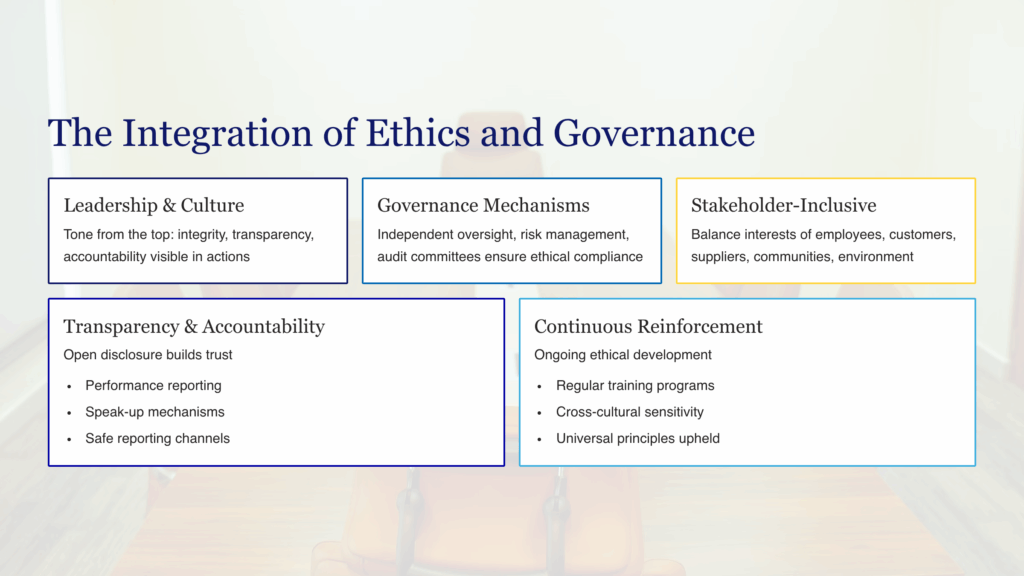
The Integration of Ethics and Governance
1. Leadership and Culture: Setting the Tone from the Top
Every ethical organization begins with leadership. The board and senior management must set the tone from the top, embodying the values they expect others to follow. Integrity, transparency, and accountability must be visible in their actions, not merely written in policies.
Defining a clear purpose and set of values helps anchor decision-making, particularly in fast-changing industries. Codes of conduct, ethics training, and regular reinforcement of these principles create a culture where employees understand not just what is expected, but why it matters.
2. Governance Mechanisms: Oversight and Control
Sound governance ensures that ethical principles are not left to chance. Independent oversight by non-executive directors provides essential checks and balances, ensuring that management decisions are objective and aligned with the company’s best interests.
Strong risk management and internal control systems act as sentinels against misconduct, ensuring adherence to laws and minimizing fraud. The audit committee, in particular, plays a vital role in promoting ethical compliance, reviewing related party transactions, and ensuring financial transparency.
Additionally, remuneration policies must be aligned with ethical conduct and long-term value creation – not short-term profit maximization. Incentive systems that encourage reckless behavior or exploitation often erode trust and invite regulatory scrutiny.
3. Stakeholder-Inclusive Decision-Making
Ethical governance today extends beyond shareholders. It recognizes that businesses operate within a complex web of stakeholders – including employees, customers, suppliers, communities, and the environment.
Boards must adopt a stakeholder-inclusive approach, balancing the interests of all these groups in pursuit of sustainable success. By doing so, they reinforce legitimacy and build the social capital necessary for resilience and growth.
4. Transparency, Accountability, and Speak-up Culture
Transparency is the currency of trust. Open disclosure of performance, ownership, and decision-making processes ensures that companies remain answerable to their stakeholders.
Just as important are speak-up mechanisms – confidential channels that allow employees and partners to report unethical behavior without fear of retaliation. Such systems are not just regulatory requirements; they are reflections of a company’s moral confidence. When people can question, challenge, and report wrongdoing safely, ethical culture becomes real.
5. Continuous Reinforcement: Training and Cross-Cultural Sensitivity
Finally, ethical governance is an ongoing process. Continuous training and reinforcement ensure that employees understand ethical expectations, even across cultures. Global organizations must remain sensitive to local norms while upholding universal principles of fairness, human rights, and sustainability.
The Interdependence of Governance and Ethics
Corporate ethics and governance are two sides of the same coin. Ethics without governance lacks enforcement; governance without ethics lacks purpose. Together, they ensure that power is exercised responsibly, decisions are made transparently, and success is pursued sustainably.
The result is not just a compliant organization but a credible one – a company that earns trust, attracts talent, and endures. In a world where reputations can be built or broken overnight, ethical governance is no longer optional; it is existential.
In essence, corporate governance provides the structure, but ethics gives it soul. Only when both coexist harmoniously can business truly serve society, and in doing so, sustain its own legitimacy and longevity.
The Evolving Scope of Corporate Governance
The scope and complexity of corporate governance have expanded considerably in recent years, driven by a rapidly changing business environment, heightened stakeholder expectations, globalization, and continuous regulatory reform. This broadening of board responsibilities—sometimes described as “scope creep”—reflects how governance has evolved from a narrow focus on financial performance to a multidimensional system encompassing sustainability, ethics, technology, and resilience.
1. Shift Toward Stakeholder Inclusivity and Sustainability (ESG)
Perhaps the most significant evolution in corporate governance has been the shift from a shareholder-centric model to a stakeholder-inclusive framework. Traditional governance, especially under the Anglo-American model, viewed the maximization of shareholder value as the primary corporate objective. However, modern governance now recognizes that long-term value creation depends on maintaining responsible and ethical relationships with a broader set of stakeholders—employees, customers, suppliers, creditors, communities, and the environment.
This transformation has been accelerated by the global momentum around Environmental, Social, and Governance (ESG) principles. The 2007–2008 financial crisis underscored the limitations of purely financial oversight and exposed how short-term profit pursuits can threaten both societal welfare and corporate sustainability. Since then, integrating sustainability into governance structures has become a mainstream expectation.
- Mandatory ESG Reporting: Legislative and regulatory developments such as the EU’s Non-Financial Reporting Directive (NFRD) and the Corporate Sustainability Reporting Directive (CSRD) have expanded corporate disclosure requirements to include environmental, social, and anti-corruption issues. These frameworks compel boards to take ownership of sustainability-related governance and ensure credible, assured reporting.
- Board Oversight of Sustainability: Boards are now explicitly expected to oversee sustainability strategy, policy, and internal controls, ensuring integration into overall business strategy. According to recent surveys, over 70%[1] of jurisdictions require or recommend that boards approve sustainability policies.
- Global Standards: The 2023 G20/OECD Principles of Corporate Governance formalized this evolution by introducing a new chapter on “Sustainability and Resilience.” This addition recognizes that good governance must include long-term environmental and social stewardship, as well as preparedness for systemic risks such as climate change and technological disruption.
2. Expanding Scope of Risk Management and Internal Controls
Historically, the oversight of risk and internal controls fell primarily within the remit of audit committees, focused largely on financial reporting and compliance. Today, risk oversight has broadened dramatically to include non-financial and strategic risks—from supply chain vulnerabilities and social risks to data privacy and geopolitical disruptions.
- Broadened Mandate: Many organizations have evolved their audit committees into “audit and risk committees”, reflecting this widened scope. In fact, the proportion of jurisdictions mandating board-level responsibility for risk management increased from 62% in 2014 to 92% in 2024[2].
- Internal Control Assurance: The UK Corporate Governance Code (2024 revision) reinforces this trend by requiring boards to issue a formal declaration on the effectiveness of internal controls—a measure that elevates accountability.
- Third-Party and Supply Chain Risks: Modern governance frameworks extend oversight beyond corporate boundaries to include third-party risks, especially those arising from complex global supply chains. Environmental, labor, and cyber risks are now treated as integral elements of enterprise risk management.
This shift highlights a fundamental change: risk governance is no longer about avoiding financial loss but about safeguarding organizational resilience, integrity, and reputation.
3. Emerging Areas of Digital and Technical Governance
The digital revolution has added new layers of responsibility to corporate oversight. Matters once confined to IT departments—such as data security and algorithmic bias—are now recognized as core governance issues with ethical, legal, and reputational implications.
- Cybersecurity: Cyber risk has emerged as one of the principal risks for modern enterprises. Boards and audit committees are increasingly expected to understand and oversee cybersecurity strategies, including incident response, data protection, and business continuity.
- Artificial Intelligence (AI) and Data Ethics: With the accelerating adoption of AI, governance frameworks must grapple with new ethical and operational dilemmas—ranging from algorithmic transparency and privacy concerns to potential misuse or bias. The oversight of AI systems now intersects with traditional risk management and ethical responsibility, requiring boards to evaluate not only compliance but also the moral implications of technology.
- Tax and Legal Governance: Strong tax governance has also gained prominence. Oversight of tax strategy, policy, and disclosure is now seen as part of responsible corporate citizenship, ensuring fairness, transparency, and compliance in fiscal matters.
- Conflicts of Interest and Related Party Transactions (RPTs): As businesses grow in complexity, managing potential conflicts—particularly in RPTs—has become a central governance challenge. Effective governance frameworks ensure such transactions are scrutinized and approved independently, safeguarding against abuse of power or undue influence.
4. The Rising Complexity and Demands on Boards
The expansion of governance responsibilities brings not only new domains of oversight but also greater demands on time, expertise, and independence.
Establishing Corporate Governance Aligned with Ethical Standards
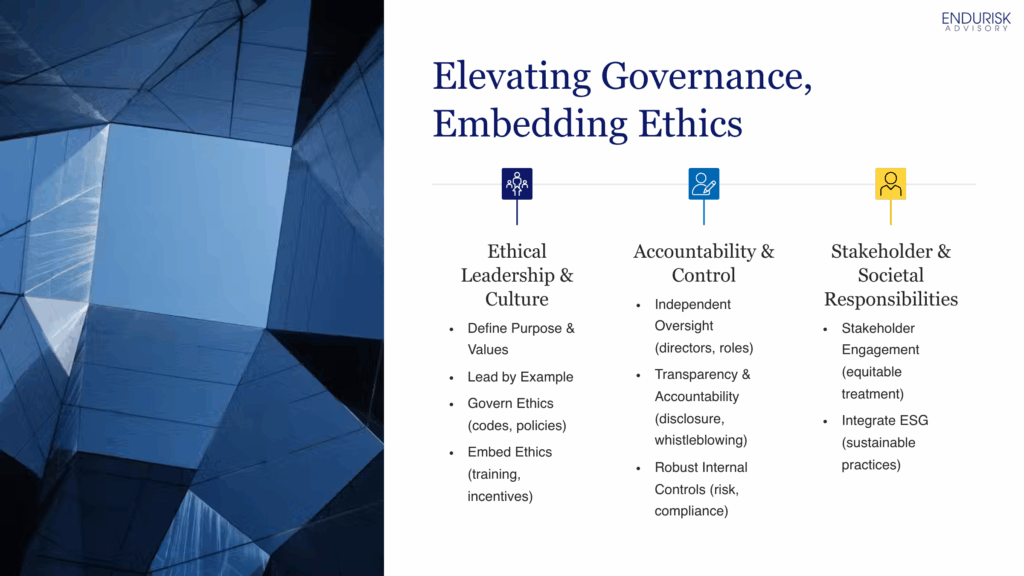
To establish a corporate governance framework aligned with ethical standards, a business must integrate moral principles into its leadership, culture, and operational structures. This integration moves beyond the mechanical compliance of laws toward proactively cultivating a culture of integrity, accountability, and responsible decision-making. When implemented effectively, such governance ensures that every decision benefits not only shareholders but also the broader community of stakeholders—employees, customers, suppliers, regulators, and society at large.
A strong ethical governance framework should be designed to achieve four interrelated outcomes: Ethical Culture, Good Performance, Effective Control, and Legitimacy. The following guide draws from leading global frameworks such as the G20/OECD Principles of Corporate Governance (2023), the UK Corporate Governance Code, and South Africa’s King IV Code.
I. Foundational Direction: Ethical Leadership and Culture
The foundation of ethical governance is ethical leadership. The tone at the top determines the moral tenor of the entire organization. Ethical leadership defines the company’s purpose and values, shapes its culture, and ensures that integrity underpins every strategic and operational decision.
1. Define Purpose, Values, and Ethical Leadership
The governing body—typically the board—must lead both ethically and effectively.
- Establish Core Purpose and Values: The board should clearly define the company’s purpose and values, ensuring that these align with long-term strategy and shape the organization’s culture. This alignment becomes the lens through which all decisions are evaluated.
- Demonstrate Integrity: Members of the board must exemplify integrity, competence, responsibility, fairness, and transparency. Acting ethically must go beyond legal compliance—directors should act in good faith, avoid conflicts of interest, and demonstrate moral courage in decision-making.
- Set the Tone at the Top: Directors and senior executives must lead by example. The audit committee can play a pivotal role in championing ethical behavior, ensuring that integrity and accountability are reflected in both policy and conduct.
- Govern Ethics: The board should define the company’s ethical approach by approving formal codes of conduct and ethics policies. These must not be static documents but living references that guide behavior and decision-making across the organization.
2. Embed Ethics Throughout the Organization
An ethical framework gains meaning only when embedded into daily practices and behaviors.
- Implement a Code of Conduct: The organization should develop a comprehensive code of conduct outlining acceptable behavior, ethical standards, and boundaries for all business activities.
- Education and Communication: Ethical expectations must be clearly communicated and reinforced through ongoing training, internal communications, and employee induction programs.
- Align Incentives: Reward systems should promote integrity and responsible risk-taking. Ethical behavior must be integrated into performance evaluations, promotions, and compensation structures.
- Monitor and Enforce: The board must oversee adherence to ethical standards through independent reviews, ethical audits, and clear disciplinary mechanisms for violations. Ethical governance loses credibility when breaches go unaddressed.
II. Structural Oversight: Accountability and Control
A governance framework aligned with ethics requires strong accountability, transparency, and oversight. These mechanisms ensure that power is exercised responsibly, conflicts of interest are managed, and decisions are made in the company’s best long-term interest.
1. Promote Independent Oversight
Independence and objectivity are fundamental to ethical governance.
- Independent Directors: Boards should include a sufficient number of independent directors to ensure impartial judgment, particularly in areas such as financial reporting, related party transactions, and executive remuneration.
- Separation of Roles: To prevent the concentration of power, it is considered good practice to separate the roles of the Chair and CEO. This division strengthens both accountability and independence.
- Conflict Management: The board must establish mechanisms to identify and manage conflicts of interest. Directors with a conflict must disclose their interests and recuse themselves from related discussions and decisions.
2. Ensure Transparency and Accountability
Transparency builds trust, while accountability ensures that trust is well-placed.
- Disclosure and Transparency: The governance framework must ensure timely and accurate disclosure of financial and non-financial matters, including performance, sustainability initiatives, ownership, and governance processes.
- Whistleblowing Mechanisms: Effective speak-up or whistleblowing arrangements are essential. They should allow employees and stakeholders to report unethical conduct confidentially and without fear of retaliation. The audit committee often oversees these mechanisms.
- Integrity of Reporting: Boards must ensure that the organization’s accounting, sustainability, and risk reporting are accurate and reliable. External auditors should maintain independence and objectivity, with the board overseeing their appointment and performance.
3. Implement Robust Internal Controls
Strong internal controls are the operational foundation of ethical governance.
- Risk Management: The board must maintain an effective risk management and internal control framework that identifies, assesses, and mitigates key risks—including ethical, reputational, and compliance risks.
- Compliance Programs: Comprehensive compliance programs should extend across subsidiaries and business partners. They must not only prevent legal breaches but also embed a culture of ethical responsibility, particularly concerning anti-corruption, anti-bribery, and fair competition.
III. Stakeholder and Societal Responsibilities
Ethical corporate governance demands that organizations act as responsible corporate citizens, recognizing their role within a broader social and environmental ecosystem. The stakeholder-inclusive approach, as emphasized in King IV, acknowledges that the organization’s legitimacy depends on how it manages relationships with all its stakeholders.
1. Stakeholder Engagement and Fairness
- Fair Treatment: Governance structures should ensure that all stakeholders—shareholders, employees, customers, suppliers, and communities—are treated equitably.
- Stakeholder-Inclusive Approach: Boards should balance the legitimate interests and expectations of all material stakeholders, ensuring that the company’s operations create sustainable value for the collective good. Meaningful stakeholder engagement builds trust, mitigates reputational risks, and fosters long-term loyalty.
2. Integrate Sustainability and Corporate Citizenship (ESG)
In today’s context, ethical governance is inseparable from sustainability.
- Corporate Citizenship: The company must acknowledge its responsibilities toward society and the natural environment, embedding ethical and sustainable practices into its strategy.
- Oversee ESG Risks: Boards must actively oversee material sustainability risks and opportunities, especially those linked to climate change, labour rights, and environmental stewardship.
- Supply Chain Ethics: Ethical governance extends beyond the company’s walls. Boards should ensure that supply chain partners adhere to principles of human rights, fair labor, and environmental protection, reinforced through due diligence and periodic reviews.
- Avoid Greenwashing: Ethical governance requires authenticity. Misleading or exaggerated claims about environmental or social performance—known as greenwashing—undermine credibility and investor confidence. Boards must institute clear review processes to ensure ESG disclosures are accurate and verifiable.
Establishing a corporate governance framework rooted in ethics is not about adding another layer of compliance—it is about building integrity into the DNA of the organization. Ethical governance combines structure with spirit: robust oversight mechanisms ensure control, while ethical culture ensures conscience.
When leadership demonstrates integrity, when systems reinforce accountability, and when every stakeholder is treated with fairness and respect, corporate governance evolves from a procedural exercise into a living expression of corporate purpose.
In essence, ethical governance is not only good ethics—it is good business. It protects reputation, enhances resilience, and ensures that success is both sustainable and legitimate.
How Endurisk can help in building an ethical environment
At Endurisk Advisory, we help organisations build governance systems that are grounded in ethics, transparency, and accountability. Our work goes beyond compliance — we focus on shaping cultures of integrity and ensuring that ethical principles are embedded in every decision and process. Drawing on our expertise in risk, forensics, and sustainability, we work with boards and leadership teams to strengthen structures, enhance trust, and align governance with long-term value creation.
Through Endurisk, we:
- Design and strengthen governance frameworks aligned with international best practices such as the OECD and King IV principles.
- Develop and implement ethics and whistleblowing programmes that promote openness, fairness, and accountability.
- Conduct governance and control reviews, helping organisations identify and address weaknesses in oversight and ethical alignment.
- Integrate sustainability and ESG considerations into governance, risk management, and disclosure processes.
- Provide independent assurance and board training, supporting leaders in translating ethical standards into measurable governance outcomes.
[1] OECD Corporate Governance Factbook 2025
[2] OECD Corporate Governance Factbook 2025