
Integrity in Voluntary Carbon Markets (VCMs)
The Voluntary Carbon Market (VCM) has grown into a key mechanism for mobilizing private capital to address climate change. Yet its credibility is under scrutiny. Concerns about greenwashing, inconsistent standards, and ineffective projects threaten to undermine trust.
At the center of efforts to rebuild confidence is the Integrity Council for the Voluntary Carbon Market (ICVCM), which has introduced the Core Carbon Principles (CCPs). These principles set a global benchmark for what high-integrity carbon credits must represent: real, verifiable, and socially responsible climate outcomes.
Integrity is not a box to be ticked—it is the foundation upon which the VCM’s future rests.
The Three Pillars of Integrity in VCMs
The ICVCM’s CCPs are structured across three critical pillars:
1. Governance: Accountability and Transparency
Carbon-crediting programs must demonstrate:
- Effective governance with independent oversight, annual disclosures, and anti-corruption safeguards.
- Secure tracking systems that prevent double issuance and double use.
- Transparency, ensuring public access to project information.
- Independent third-party validation and verification, accredited to global standards.
2. Emissions Impact: Real and Durable Climate Benefits
Every carbon credit must rest on scientific and financial rigor:
- Additionality: Projects should deliver reductions/removals that would not happen without carbon finance.
- Permanence: Long-term monitoring and pooled reserves safeguard against reversals, especially in land-use projects.
- Robust quantification: Conservative baselines, leakage accounting, and ex-post issuance.
- No double counting: Ensuring a single ton of CO₂ reduced/removed is credited only once.
3. Sustainable Development: Beyond Carbon
Carbon credits must generate co-benefits and uphold safeguards:
- Respect for human rights and labor rights.
- FPIC (Free, Prior, and Informed Consent) with Indigenous Peoples and Local Communities.
- Biodiversity protection and resource efficiency.
- Alignment with the net-zero transition, avoiding lock-in of fossil-intensive activities.
A Roadmap for Businesses: Ensuring Integrity in Carbon Credit Procurement
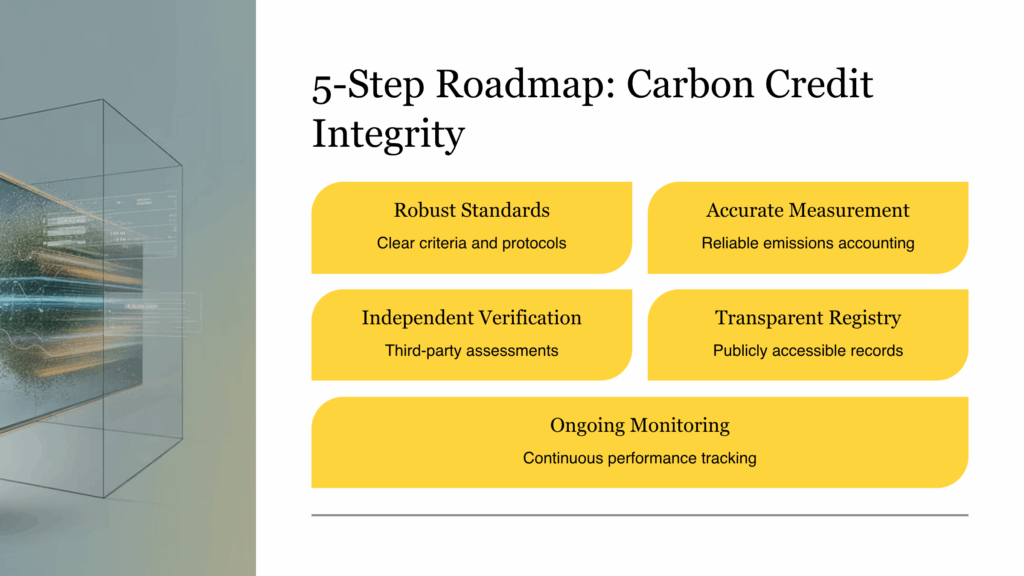
For companies, translating principles into practice requires a structured approach. Here are five steps to navigate the VCM with confidence:
1. Understand What Makes a High-Quality Credit
A credible credit represents one tonne of CO₂ reduced or removed that is additional, permanent, measurable, unique, and causes no harm. Businesses should assess every project against these benchmarks.
2. Prioritize CCP-Labeled Credits
The CCP label is designed to signal integrity:
- Check whether the program is CCP-Eligible.
- Confirm if the project’s category is CCP-Approved.
- Prefer recent vintages, as methodologies are continually being strengthened.
3. Use Independent Ratings and Certifications
Complement CCP assessments with independent ratings (e.g., BeZero, Sylvera, Calyx Global). Look for co-benefit certifications (e.g., CCB, SD VISta) or verified SDG contributions, particularly if credits are tied to ESG commitments.
4. Demand Transparency and Conduct Due Diligence
- Review project design documents, calculations, and methodologies.
- Confirm independent Validation and Verification Bodies (VVBs).
- Examine leakage risks and mitigation.
- Assess financial viability to ensure carbon revenues are essential for project success.
5. Stay Engaged in Market Evolution
- Monitor regulatory shifts, especially around Article 6 of the Paris Agreement.
- Track ICVCM’s ongoing refinements, including digital MRV and Paris alignment.
- Engage in industry dialogues (VCMI, CCQI) to stay ahead of standards.
The Business Case for Integrity
The VCM is experiencing a “flight to quality.” Buyers and investors increasingly demand high-integrity credits, rewarding them with stronger demand and higher prices. Those who continue to buy low-integrity credits risk reputational damage, stakeholder pushback, and stranded assets.
Integrity is not optional. For businesses, it is the price of entry into credible climate leadership. By aligning procurement strategies with the ICVCM’s CCPs and applying rigorous due diligence, companies can ensure that their carbon credits deliver not just symbolic offsets—but genuine climate and social impact.