

Understanding Financial Risks from Climate Change
Climate change is not just an environmental concern. It has emerged as a significant financial risk that can affect businesses, economies, and financial institutions alike. As the physical impacts of a warming planet intensify and the transition to a low-carbon economy accelerates, organizations are exposed to two major categories of climate-related financial risks: physical risks and transition risks.
Global regulators, investors, and stakeholders are urging companies to take these risks seriously—embedding climate considerations into risk management frameworks, investment decisions, and long-term planning. Let’s break down these risks and what they mean for businesses and financial actors today.
I. Physical Risks: Weathering the Immediate and Long-Term Impacts
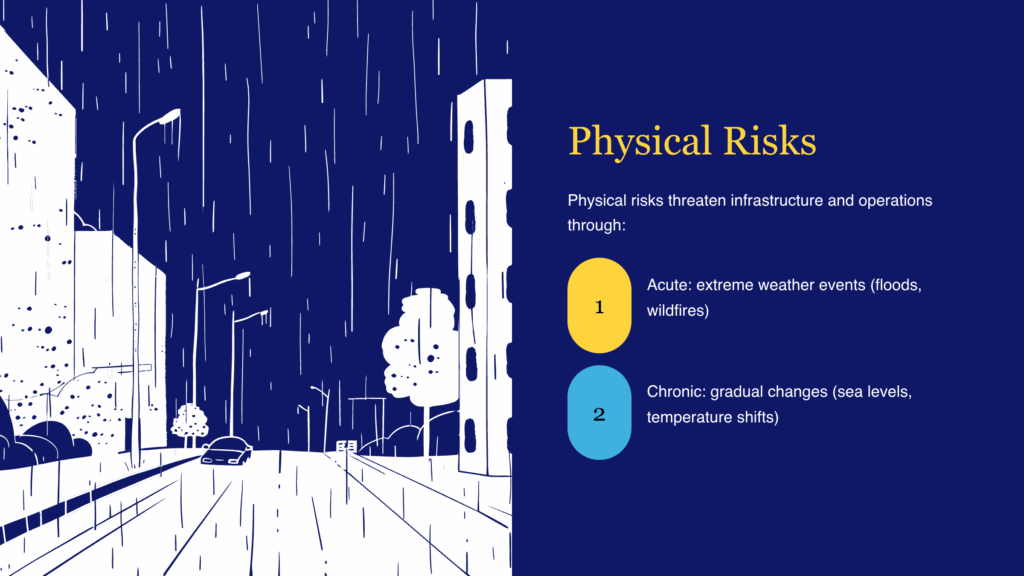
Physical risks stem from the direct effects of a changing climate on assets, infrastructure, people, and operations. These are classified into:
- Acute physical risks, such as extreme weather events—floods, wildfires, hurricanes, and heatwaves—that are increasing in frequency and severity.
- Chronic physical risks, including gradual changes in climate patterns—rising sea levels, long-term temperature shifts, and altered precipitation.
These risks have significant financial consequences. For instance:
- Operational disruptions: Flooding or extreme heat may halt production or reduce workforce availability.
- Credit risk: Borrowers affected by climate events may default, especially if their income or assets are hit (e.g., in agriculture or real estate).
- Market risk: Climate-exposed assets, such as coastal properties or agriculture-linked securities, may lose value.
- Insurance risks: Increased claims and uninsurable properties can destabilize insurers.
- Litigation risk: Failure to disclose or act on known physical risks may trigger legal action.
Moreover, second-order effects—like forced migration, disease proliferation, and supply chain instability—can ripple through the economy.
Modeling and Managing Physical Risks
To quantify these impacts, financial institutions and companies are developing tools that combine hazard, exposure, and vulnerability metrics. One such tool is the Physical Climate Risk Appraisal Methodology (PCRAM), which helps map climate hazards to specific assets and assess their resilience.
However, data remains a key constraint. High-quality, granular asset-level data—like building characteristics or insurance coverage—is often missing. Disclosures on physical risks are less advanced than those for transition risks and vary widely in definitions, metrics, and scope.
Solutions include:
- Integrating third-party models and open-source climate data.
- Applying stress testing using climate scenarios.
- Combining engineering, financial, and climate expertise for thorough risk evaluation.
- Developing risk-adjusted financial models that incorporate climate-adjusted credit risk, asset pricing, and operational risk estimates.
Adaptation and Resilience Strategies
Effective mitigation goes beyond quantification:
- Adaptive capacity (organizational readiness and governance) must be strengthened.
- Investments in resilience, both structural (e.g., flood defenses) and operational (e.g., relocating critical assets), help reduce exposure.
- Innovative insurance mechanisms, such as parametric products, offer early payouts based on triggers like wind speed or flood depth—rather than post-loss assessments.
- Linking risk mitigation to financing terms—such as better lending rates for resilient infrastructure—can incentivize proactive adaptation.
II. Transition Risks: Navigating the Shift to a Low-Carbon Economy
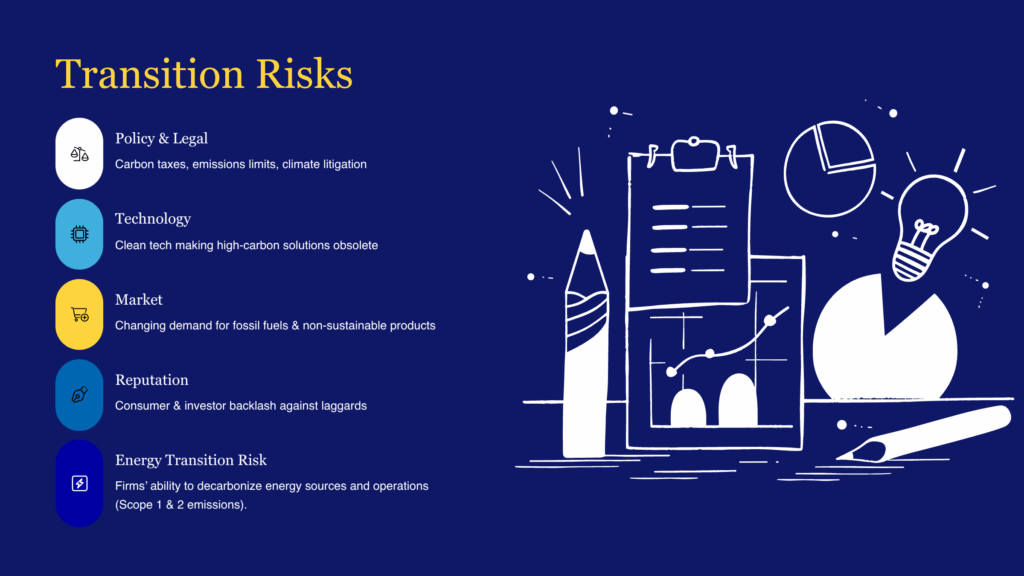
While physical risks relate to climate impacts, transition risks emerge from how the world responds to climate change. These risks arise from the policies, technologies, and societal shifts required to meet climate goals—especially those aligned with the Paris Agreement.
Key drivers include:
- Policy and Legal Risks: Carbon taxes, emissions limits, mandatory disclosures, and climate litigation.
- Technology Risks: Rapid development of clean technologies rendering high-carbon solutions obsolete (e.g., coal plants, internal combustion engines).
- Market Risks: Changing demand and pricing structures—for instance, declining interest in fossil fuels or non-sustainable products.
- Reputational Risks: Consumer and investor backlash against companies lagging in sustainability efforts.
- Energy Transition Risk: Firms’ ability to decarbonize energy sources and operations (Scope 1 & 2 emissions).
Stranded assets—assets that lose value prematurely—are a real threat in this context, impacting not just fossil fuel sectors but also real estate, agriculture, and heavy manufacturing.
Assessing Transition Risk
Assessing these risks requires understanding emission profiles, policy developments, technological disruptions, and stakeholder sentiment. Tools used include:
- Carbon Performance Analytics: Tracking and forecasting emissions trajectories.
- Value-at-Risk (VaR) and Transition VaR (TVaR): Estimating portfolio losses under different transition scenarios.
- Net-Zero Pathway Tools: Evaluating alignment with 1.5°C or 2°C pathways.
Data challenges persist—especially for Scope 3 emissions, which cover upstream and downstream impacts in the value chain. Nonetheless, advanced AI tools like large language models can now parse public filings (e.g., 10-Ks) to identify climate-related risks and opportunities.
Transition plans must be credible, front-loaded, and externally verifiable. Joining global campaigns like the Race to Zero, setting science-based targets, and regularly reporting progress under TCFD are crucial steps for businesses.
III. Cross-Cutting Challenges and Regulatory Momentum
Climate risk management today faces multiple hurdles:
- Data gaps and inconsistencies, especially at the asset and regional levels.
- Uncertainty in climate models and the need to translate scenarios into financial outcomes.
- Lack of standardized disclosures, making peer comparison and market pricing difficult.
- Fragmented regulatory frameworks—though momentum is growing for alignment.
Regulators are stepping up:
- The Task Force on Climate-related Financial Disclosures (TCFD) provides a robust structure for identifying and reporting climate risks.
- The International Sustainability Standards Board (ISSB) and IAASB are advancing global reporting and assurance standards.
- Jurisdictions like the EU, UK, Hong Kong, and Singapore are mandating climate disclosures and risk integration.
- Green taxonomies now help classify sustainable investments, but inconsistencies and lobbying remain challenges.
Enterprises are being encouraged to embed climate risks into Enterprise Risk Management (ERM) frameworks—defining climate-related risk appetites, evaluating strategic implications, and monitoring performance.
IV. Climate Change as a Systemic Risk
Climate risk is not confined to any one sector—it is systemic. It can affect everything from property values and supply chains to insurance markets and sovereign credit ratings. Financial institutions with significant exposures may face simultaneous pressures: declining asset values, rising defaults, liquidity crunches, and even regulatory sanctions.
This raises the risk of a “climate Minsky moment”—a sudden and dramatic repricing of assets once the true scale of climate exposure becomes evident. The Network for Greening the Financial System (NGFS) has been proactive in studying how adaptation finance, protection gaps, and macroprudential risks are interconnected.
How Endurisk Advisory Can Help
At Endurisk Advisory, we specialize in guiding businesses and financial institutions through the evolving landscape of climate-related financial risks. Our services include:
- Climate Risk Assessments for both physical and transition risks across portfolios and sectors.
- Scenario Analysis & Stress Testing, aligned with global frameworks like TCFD and ISSB
- Development of Net-Zero Transition Plans, including interim target setting and implementation roadmaps.
- Risk Modeling & Due Diligence support for investors, lenders, and corporates.
- Training and Capacity Building for boards, leadership teams, and risk professionals.
Our multidisciplinary approach combines technical knowledge, regulatory insight, and practical experience to build resilience and long-term value.
Climate risk is no longer a distant threat—it’s a present financial reality. Let Endurisk help you anticipate, adapt, and thrive in the transition to a climate-resilient economy.
Connect with us to explore how we can partner on your climate risk journey.